Slide 1 of 4
Slide 2 of 4
Text “FAMILY” to 47226 for up to 20% off full price items
Slide 3 of 4
Slide 4 of 4
Your Browser Is No Longer Supported. Please use an alternative browser to improve your experience and security.
Many families consider adding a baby swing when they’re looking for ways to soothe their baby. Some babies respond well to motion, and parents often appreciate having a secure place to set baby down while staying close.
It’s completely normal to have questions about safety, weight limits, newborn use, and how long a baby can stay in a swing. When used thoughtfully and safely, a swing can be a helpful part of your routine, offering a place for baby to stay engaged and content.This guide walks through baby swing basics in a clear, practical way so you can decide what fits your space, your routine, and your baby.
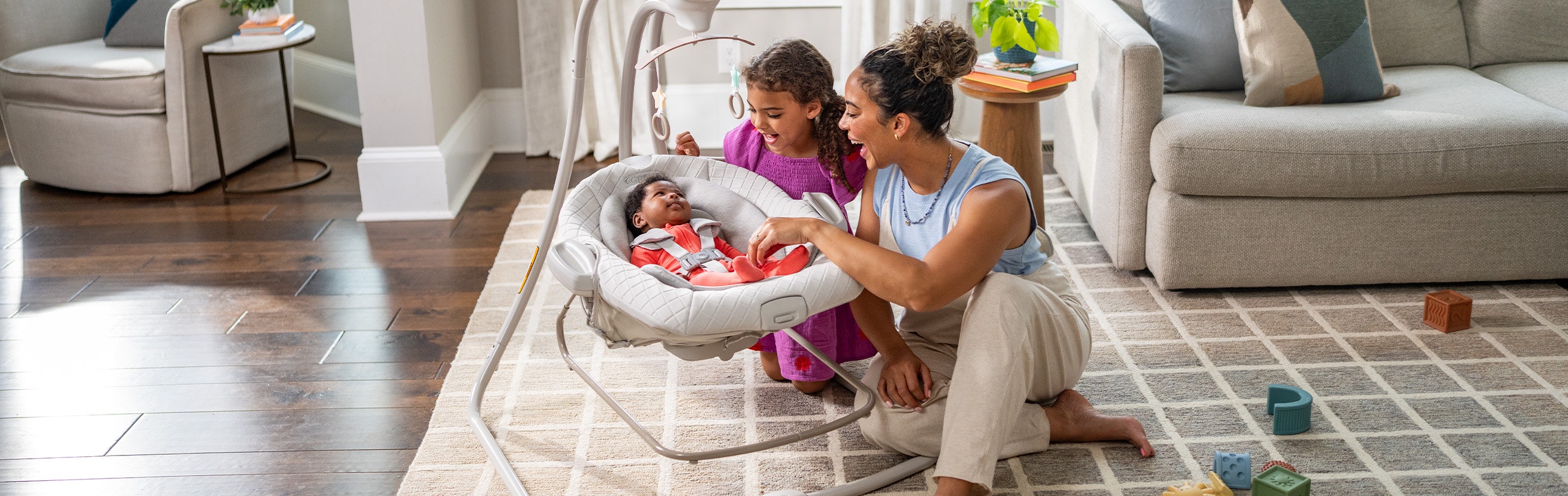
Families may use ababy swingto:
Yes, baby swings can be safe when used according to the product manual and when baby is awake and supervised.
To use a swing safely:
According to the American Academy of Pediatrics, you should remove your baby from the swing if they become drowsy and place them on a firm, flat surface for sleep, such as a bassinet.
Many swings are designed for use from birth if your baby meets the minimum weight requirement.
During the newborn stage:
Some families appreciate swings that include extra infant support during early weeks. For example, the Slim Spaces™ Compact Baby Swing includes cocooning infant support and a reclined seat designed to help keep newborns positioned comfortably. The Simple Sway™ Baby Swingincludes a deep seat with removable infant support, which some families appreciate during the early months.
Always review your specific model’s instructions before first use.

Generally, swings include a stated minimum and maximum weight limit. These limits vary by model and are based on product design and testing.
Some multi-use models include separate limits for different modes. For example, the DuetConnect™ LX Baby Swing and Bouncersupports up to 30 lb in swing mode and up to 18 lb in bouncer mode, while the Soothe My Way™ Swing with Removable Rockersupports 5.5 to 25 lb in swing mode and 5.5 to 18 lb in rocker mode.
Always review your product manual to confirm the weight limits and recommended use for your specific model.
There is no single time limit that fits every baby. Instead of focusing on exact minutes, think about variety throughout the day.
Baby swings can be a helpful part of your routine during awake time. Spending extended time in one position, however, can:
Changing positions throughout the day helps support development. A swing can fit naturally into that rotation while still giving your baby time to move, stretch, and explore in other ways.
A baby swing can be one part of your day, not the main setting.
Many families use a swing during:
It can help to think of the swing as a temporary spot rather than a primary space. The American Academy of Pediatricsencourages caregivers to vary a baby’s position while awake and limit extended time in devices such as swings and bouncy seats. Changing positions supports motor development and reduces prolonged pressure on one area of the head.
A swing can fit into that rotation naturally. Use it during short, supervised moments, then transition to another activity when your baby shows signs of wanting to move, stretch, or engage.
Keeping the day varied often supports your baby’s development more than relying heavily on one product.
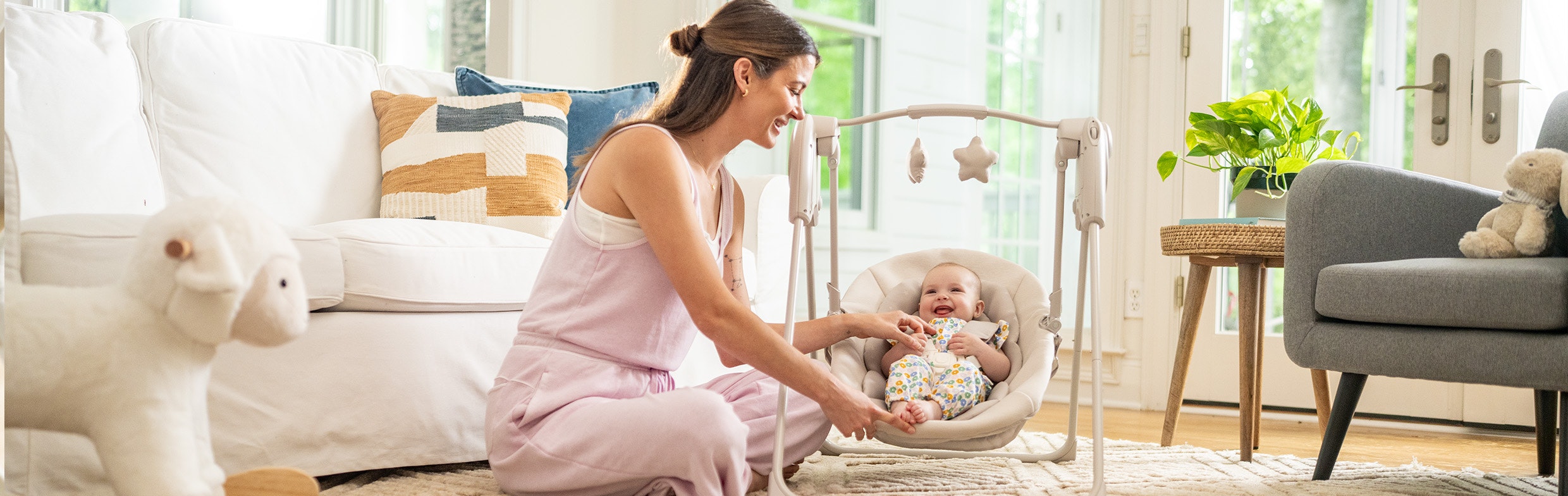
Once you’ve decided a swing may be helpful, the next step is choosing one that fits your space and daily flow.
Different baby swing designssupport different family needs and spaces.
If you live in a smaller home or plan to move the swing between rooms, a compact design may feel easier to manage.
The Slim Spaces™ Compact Baby Swing is foldable and has a built-in carry handle to move the product easily from room to room. That flexibility can make setup and storage simpler.
Some caregivers prefer a plug-in option rather than relying only on batteries.
The Simple Sway™ Baby Swing offers a plug-in option, six swing speeds, two vibration settings, and 15 songs and nature sounds. Having different motion and sound options can help you find what feels most calming for your baby.
If you like the idea of moving baby from room to room in the same seat, a swing-and-bouncer combination may make sense.
The DuetConnect™ LX Baby Swing and Bouncer is designed to function as both a stationary swing and a portable bouncer. The seat can be removed from the swing base and used separately, giving you two ways to use the same seat depending on where you are and what your routine looks like.
Some babies respond differently to different motion patterns, so having options can make it easier to find what feels most calming.
The Soothe My Way™ Swing with Removable Rocker offers eight motions in two directions for 16 soothing combinations. It also includes a removable rocker seat that can be used separately.
If you’re looking for a swing that can adjust automatically, responsive features may be worth considering. These features can help support you during unsettled moments by adapting to your baby’s cues.
The SmartSense™ Soothing Baby Swing, for example, can detect when your baby is crying and cycle through soothing combinations of motion, sound, and vibration, adjusting until your baby is calm.
Babies grow quickly, and their mobility can change from week to week.
It’s time to stop the swing when your baby reaches the maximum listed weight or attempts to climb out.
Even if your baby still enjoys the motion, increased mobility can change how safely the swing can be used. If your baby can move from lying down to sitting up without help or pushes strongly against the harness, it may be time to transition away from the swing. Always follow the limits in your product manual.
Most swing-related concerns are not about the product itself, but about how it is used.
A few common mistakes to avoid include:
As babies grow stronger, they may lean, rock, or try to shift their weight. Watching for these changes helps you decide when it is time to transition away from the swing.
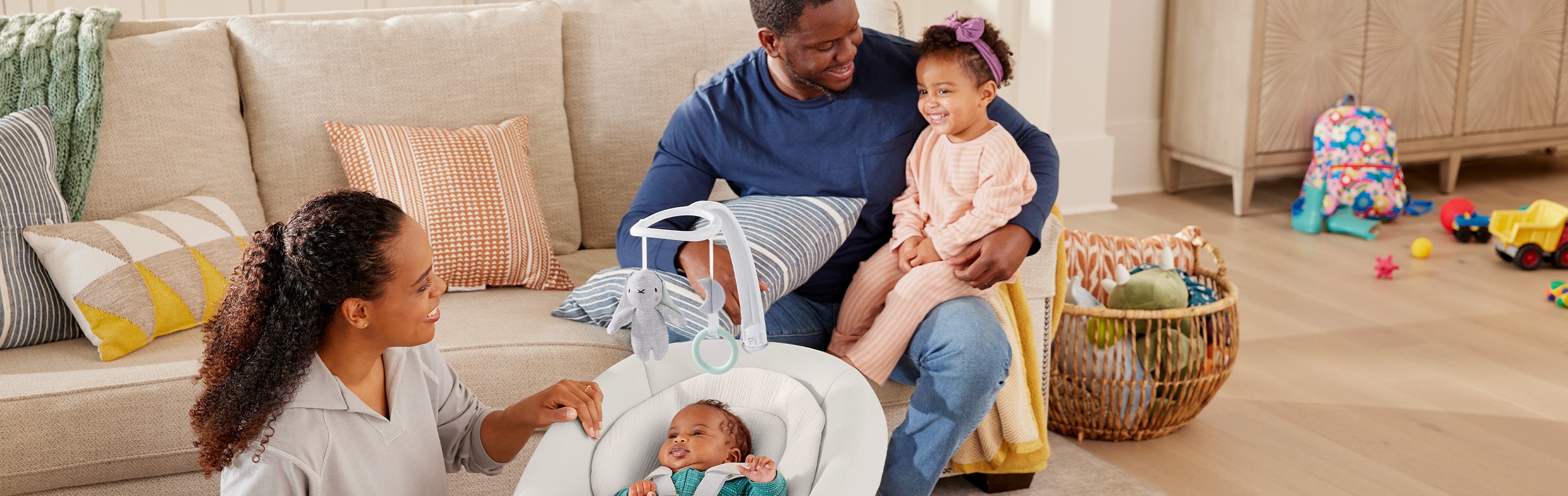
A baby swing can be a helpful soothing option during the early months when used thoughtfully and with supervision.
While it doesn’t replace interaction, supervised floor time, or safe sleep practices, it can offer gentle motion during certain parts of the day.
By understanding baby swing safety, weight limits, and feature differences, you can decide whether a swing fits your routine and which type aligns with your space and preferences.
A swing uses motorized motion to create consistent movement. A bouncer typically moves in response to your baby’s natural motion. Some models include both functions.
Graco baby swings are designed for when baby is awake, and they should be used under supervision and in accordance with the product manual. Limiting use to short periods and varying your baby’s position supports healthy development.
Consider your available space, whether you plan to move the swing between rooms, and which features matter most in your routine.
No. Some models operate on batteries, some plug into an outlet, and some offer both options. Review product specifications before purchasing.
Always follow your product's listed maximum weight limits and developmental milestones regarding when to discontinue use.